
- Planted: 种植时间:2024 年 1 月 7 日
I began using Anki in July of last year to aid my memory and learning. Although it’s still a relatively new habit for me, I’m already confident that it’ll be a key learning tool for the rest of my life with compounding benefits over time.
我从去年七月开始使用 Anki 来帮助记忆和学习。虽然这对我来说还是一个相对较新的习惯,但我已经确信,它将成为我余生的一个重要学习工具,并随着时间的推移产生复合效益。
Anki is free flashcard software that automates the timing of card review. So for example, let’s say you write a new flashcard that asks, "About how many neurons do humans have?" (about 100 billion). Anki presents that card for review immediately, you remember it and mark it as correct. The next day it presents the same card, which you remember again and mark as correct, so Anki waits a full week to present it a third time. If you get it right again, Anki will wait a month or so to surface it, and so on. Or if you get it wrong, the clock resets.
Anki 是一款免费的闪存卡软件,可以自动安排卡片复习的时间。举个例子,假设你写了一张新的闪存卡,问 "人类大约有多少个神经元?(约 1000 亿)。Anki 会立即出示这张卡让你复习,你记住了它并标注为正确。第二天,Anki 又出示了同一张卡片,您再次记住并标记为正确,于是 Anki 等了整整一周才第三次出示卡片。如果你又答对了,Anki 会等上一个月左右再把它显示出来,以此类推。如果你做错了,时钟就会重置。
There are more layers to the software, but that’s the basic premise. I’ll cover both the why of Anki for me and observations from my first six months using it.
软件还有更多层次,但这是基本前提。我将介绍我使用 Anki 的原因,以及使用 Anki 头六个月的观察结果。
Memory’s role in thinking
记忆在思维中的作用
I first learned about Anki from my partner when she was in medical school (med students use Anki heavily, often reviewing hundreds of cards per day). I thought it was neat, but I didn’t see the appeal beyond high-volume memorization domains like medicine and law. Then my coworker Danny mentioned that he’d started using Anki a few years prior after reading Augmenting Long-Term Memory by Michael Nielsen. From the essay:
我第一次了解到 Anki,是在我的搭档读医学院的时候(医学院学生大量使用 Anki,经常每天复习数百张卡片)。我觉得它很不错,但除了医学和法律等需要大量记忆的领域外,我并不觉得它有什么吸引力。后来我的同事丹尼提到,他在几年前读了迈克尔-尼尔森(Michael Nielsen)写的《增强长期记忆》(Augmenting Long-Term Memory)一书后开始使用 Anki。文章摘自
Anki can be used to remember almost anything. That is, Anki makes memory a choice, rather than a haphazard event, to be left to chance. I’ll discuss how to use Anki to understand research papers, books, and much else. And I’ll describe numerous patterns and anti-patterns for Anki use. While Anki is an extremely simple program, it’s possible to develop virtuoso skill using Anki, a skill aimed at understanding complex material in depth, not just memorizing simple facts.
Anki 几乎可以用来记忆任何东西。也就是说,Anki 让记忆成为一种选择,而不是任由机会随意摆布。我将讨论如何利用 Anki 理解研究论文、书籍和其他许多东西。我还将介绍使用 Anki 的众多模式和反模式。虽然 Anki 是一个极其简单的程序,但使用 Anki 可以培养出精湛的技能,这种技能旨在深入理解复杂的材料,而不仅仅是记住简单的事实。
I read that essay, and it immediately clicked for me. I recommend reading the full essay if you’re interested—I found it super energizing. Two key points stand out: that you can choose to remember (and choose what to remember), and that foundational knowledge is critical for accruing expertise, creating/building, and solving problems.
我读了这篇文章,立刻就被它深深吸引了。如果你有兴趣,我建议你阅读全文,我觉得它非常振奋人心。其中有两个要点非常突出:你可以选择记忆(以及选择记忆什么);基础知识对于积累专业知识、创造/建设和解决问题至关重要。
Building on Nielsen’s claim that Anki can be used for much more than memorizing simple facts, the book Make It Stick—which covers effective learning techniques supported by research—makes the case that memory is crucial for thinking and developing expertise. From the book:
尼尔森声称,Anki 的作用远不止记忆简单的事实,在此基础上,《让记忆成为习惯》一书介绍了有研究支持的有效学习技巧,说明记忆对思维和专业知识的发展至关重要。摘自本书:
Memory plays a central role in our ability to carry out complex cognitive tasks, such as applying knowledge to problems never before encountered and drawing inferences from facts already known.
记忆在我们执行复杂认知任务的能力中发挥着核心作用,例如将知识应用于从未遇到过的问题,以及从已知事实中得出推论。...
All new learning requires a foundation of prior knowledge.
所有新知识的学习都需要以原有知识为基础。...
Mastery in any field, from cooking to chess to brain surgery, is a gradual accretion of knowledge, conceptual understanding, judgement, and skill. These are the fruits of variety in the practice of new skills, and of striving, reflection, and mental rehersal... Mastery requires both the possession of ready knowledge and the conceptual understanding of how to use it.
在任何领域,从烹饪、国际象棋到脑外科手术,精通都是知识、概念理解、判断力和技能的逐步积累。这些都是在练习新技能的过程中不断变化、不断努力、不断反思、不断总结的成果......掌握技能既需要掌握现成的知识,也需要从概念上理解如何使用这些知识。
Donald Rumsfeld famously said that there are known knowns, known unknowns, and unknown unknowns. If a task requires a known known piece of knowledge or skill, we can do it. If it requires a known unknown, we can learn the prerequisite knowledge/skill then do it. But if a task requires an unknown unknown, we may not even be able to start. Having knowledge and skills readily accessible unlocks solutions that we might not have otherwise known to reach for. For example, I like learning about and tinkering with browser APIs that I haven’t yet used in my day job or a side project, like the Battery Status API or Web Speech API.
唐纳德-拉姆斯菲尔德(Donald Rumsfeld)有一句名言:有已知的已知、已知的未知和未知的未知。如果一项任务需要已知的已知知识或技能,我们就可以去做。如果需要已知的未知,我们可以先学习前提知识/技能,然后再去做。但如果一项任务需要未知的未知因素,我们可能连开始都做不到。有了随时可用的知识和技能,就能找到我们可能不知道的解决方案。例如,我喜欢学习和修补在日常工作或副业中尚未使用过的浏览器 API,如电池状态 API 或网络语音 API。
Building durable knowledge requires time, which is where traditional note-taking can fall short.
积累持久的知识需要时间,而这正是传统笔记的不足之处。
Spaced repetition and forgetting curves
间隔重复和遗忘曲线
Anki’s automated timing that I described earlier is an implementation of spaced repetition. Physical flashcards are an even simpler form. The idea is that you should allow some time to forget what you’ve learned, then test yourself just before forgetting. Each act of recall strengthens the memory trace in your brain for that knowledge and also makes connections to new things you’ve learned since the last retrieval.
我前面介绍的 Anki 自动计时就是间隔重复的一种实现方式。实物闪存卡是一种更简单的形式。其原理是,你应该留出一些时间来遗忘所学知识,然后在遗忘之前测试自己。每一次回忆都会强化大脑中对该知识的记忆痕迹,同时也会将上次回忆后学到的新知识联系起来。
This notion can be visualized by a forgetting curve, which plots retention over time. Cognitive psychologists have been plotting forgetting curves since Hermann Ebbinghaus’s self-observation study of memory in 1885. Retention starts at 100%, drops over time, jumps back to 100% upon recall, and flattens with each retrieval.
遗忘曲线可以将这一概念形象化,它描绘了随时间变化的记忆保持情况。自赫尔曼-艾宾浩斯(Hermann Ebbinghaus)于 1885 年对记忆进行自我观察研究以来,认知心理学家就一直在绘制遗忘曲线。记忆保持率从 100%开始,随着时间的推移而下降,在回忆时又跳回 100%,并在每次检索时趋于平缓。
Scroll through the forgetting curves below to visualize retention as a function of time and retrieval. Notice that the curve flattens with each retrieval as the memory trace becomes more durable.
滚动浏览下面的遗忘曲线,可以直观地看到记忆保持与时间和检索的关系。请注意,随着记忆痕迹越来越持久,每次检索后曲线都会变平。


Side note: I’d like to come back to this essay and create an interactive graph that allows you to play with forgetting curves by controlling the number of retrievals, interval of retrieval, etc.
题外话:我想再回到这篇文章,创建一个交互式图表,让您可以通过控制检索次数、检索间隔等来玩转遗忘曲线。
My first 6 months of Anki
我学习安基的前 6 个月
So I’ve been at it for about half a year—here’s the TL;DR.
因此,我已经做了大约半年--以下是简要说明。
- First card added July 29, 2023 (162 days ago)
第一张卡于 2023 年 7 月 29 日添加(162 天前) - 394 cards added total
共增加 394 张卡片 - 106/162 (65%) days studied
106/162 (65%) 研究天数
Daily studying每日学习
My initial aim was to review once per week because I thought daily would be unrealistic. Surprisingly though, my habit naturally turned into an (almost) daily morning routine without much willpower. It’s a pleasant thing to do in the morning, and there’s definitely a reward/gamification effect. Long intervals between reviews also feels burdensome because you end up with a lot of cards to review. Plus, chunking review into smaller, spaced out sessions leads to more effective learning.
我最初的目标是每周复习一次,因为我觉得每天复习是不现实的。但出乎意料的是,我的习惯自然而然地变成了(几乎)每天早上的例行公事,而无需太多的意志力。早上做这件事很惬意,而且肯定会有奖励/游戏效应。长时间的复习间隔也会让人感觉负担沉重,因为你最终会有很多卡片要复习。另外,把复习分成小块,间隔开来,能提高学习效率。
Single deck单层
I took Michael Nielsen’s suggestion of one universal deck. Having one deck feels like a more natural representation of the brain, plus the approach of interleaving the study of different topics is known to be an effective learning technique (which I learned in Make It Stick). Categorizing would also add maintenance burden.
我采纳了迈克尔-尼尔森(Michael Nielsen)的建议,使用一副万能牌。我觉得用一副扑克牌更能自然地反映大脑,而且交错学习不同主题的方法是众所周知的有效学习技巧(这是我在《让学习坚持下去》一书中学到的)。分类还会增加维护负担。
Notes as questions作为问题的笔记
Anki has significantly changed my note-taking style. Instead of writing notes while I learn in the form of statements, I create Anki cards in the form of questions. I still write some traditional notes, but I default to Ankifying new knowledge where it makes sense. Note: I am borrowing the use of "Ankify" as a verb from Nielsen.
Anki 大大改变了我记笔记的方式。我在学习时不再以语句的形式写笔记,而是以问题的形式创建 Anki 卡片。我仍然会写一些传统的笔记,但在有意义的地方,我会默认对新知识进行 "安基化"。注:我借用了尼尔森将 "Ankify "作为动词的用法。
When I first started, I would write questions for myself without answers as a sort of staging ground, then return to Ankify those questions the next day. I’d try writing answers from memory, check my answers with a quick Google search, ChatGPT query, or Wikipedia scan, then finally create the card. That was good in that it optimized for refined questions and filtered out things I didn’t think were worth remembering by the next day. But it was bad because I ended up with lots of stranded questions that I didn’t get around to adding. So I reversed course and started Ankifying things I learn immediately and directly. I like this better because my rate of card creation is faster, and I can still always edit or delete the question.
刚开始的时候,我会给自己写一些没有答案的问题,作为一个中转站,然后第二天再回来重新整理这些问题。我会试着根据记忆写出答案,然后通过快速谷歌搜索、ChatGPT 查询或维基百科扫描检查我的答案,最后创建卡片。这样做的好处是可以优化精炼的问题,并在第二天之前过滤掉我认为不值得记忆的内容。但这样做的坏处在于,我最终发现有很多搁浅的问题没有来得及添加。因此,我改变了方向,开始直接记录我学到的东西。我更喜欢这样做,因为我创建卡片的速度更快,而且我还可以随时编辑或删除问题。
Adding cards添加卡片
I also found Michael Nielsen’s suggestion of Ankifying things I’m actively applying to be helpful. For example, I learned more about SVGs in Chris Coyier’s Practical SVG book on the same day that I implemented my animated Edison bulb SVG in the top right corner of this website, so I Ankified some SVG foundations in the process. I’ll sometimes also write a TIL for things I Ankify that were particularly fun to learn and worth sharing.
我还发现迈克尔-尼尔森(Michael Nielsen)提出的将我正在积极应用的东西 Ankifying 的建议很有帮助。例如,就在我实现本网站右上角的爱迪生灯泡 SVG 动画的同一天,我在 Chris Coyier 的《实用 SVG》一书中学习到了更多关于 SVG 的知识,因此我在这个过程中对一些 SVG 基础知识进行了 Ankify。有时,我也会写一篇 TIL,介绍我 Ankify 的那些特别有趣、值得分享的东西。
Deleting cards删除卡片
I delete cards somewhat often because present me is often a poor judge of what future me will want to remember. Plus, I am building a better intuition for what makes a good card over time.
我经常删除贺卡,因为现在的我往往无法判断未来的我想要记住什么。另外,随着时间的推移,我对什么是好卡片有了更好的直觉。
For example, I’ve deleted some cards I wrote for APIs early on, like “In Next.js, how do you set static or dynamic metadata for a page?” (by exporting a static metadata object or a dynamic generateMetadata() function). Although those APIs are useful, I don’t need to memorize them because (1) they are readily accessible on API docs, and (2) more importantly, I won’t forget that I want to set metadata like title and description for a webpage—I’ll know I want to do that then look up the method as needed or let Copilot fill it in for me.
例如,我删除了一些早期为 API 编写的卡片,如 "在 Next.js 中,如何为页面设置静态或动态元数据?(通过导出静态 metadata 对象或动态 generateMetadata() 函数)。虽然这些 API 非常有用,但我并不需要记住它们,因为 (1) 它们可以在 API 文档中随时访问,而且 (2) 更重要的是,我不会忘记我想要为网页设置标题和描述等元数据--我会知道我想要这么做,然后根据需要查找方法,或者让 Copilot 帮我填写。
Visuals视觉效果
Diagrams and images can be very useful, depending on the card. I also learned from Make It Stick that there is no empirical support for the claim that preferred learning style (e.g. "visual learner") has any bearing on learning outcomes. Although learning style should fit the subject matter, e.g. visuals are important when learning geometry.
根据卡片的不同,图表和图像可能非常有用。我还从《Make It Stick》中了解到,关于偏好的学习风格(如 "视觉学习者")对学习效果有影响的说法,没有任何经验支持。尽管学习风格应与学习主题相适应,例如在学习几何时,视觉效果就很重要。
I make an effort to add visuals wherever it makes sense for a given card. For my card that asks, "What is the Dunning-Kruger effect?", I added a chart that illustrates the relationship between competence and confidence:
我努力为特定的卡片添加视觉效果。在 "什么是邓宁-克鲁格效应?"的卡片中,我添加了一张图表,说明能力和自信之间的关系:
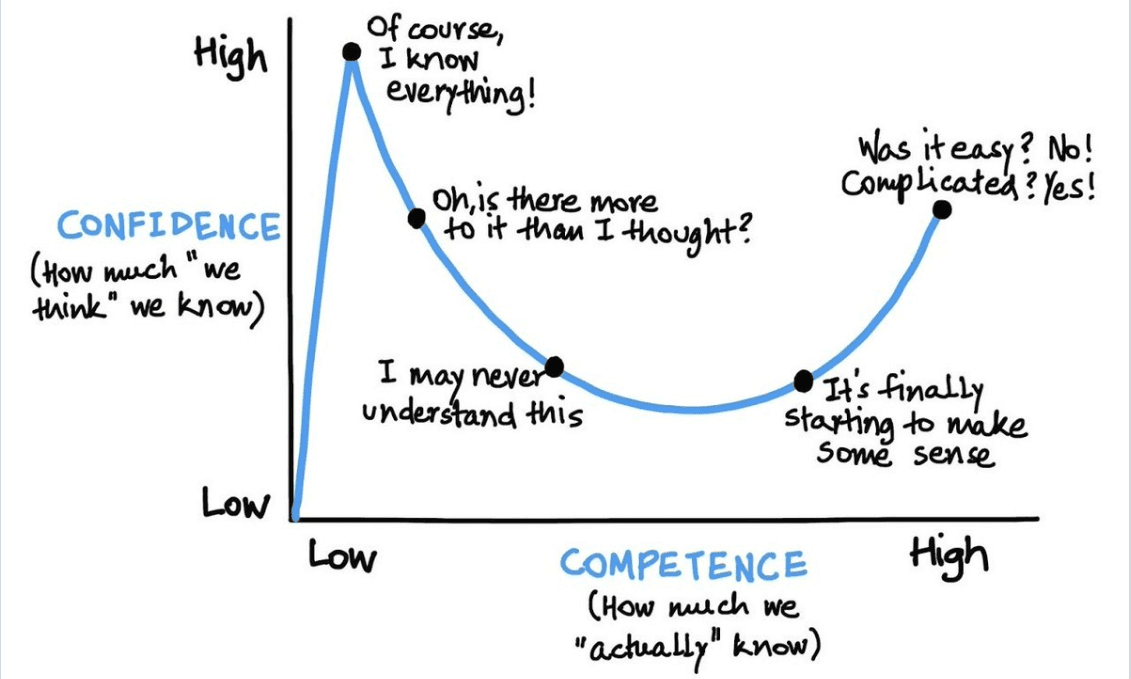
邓宁-克鲁格效应
For people, I add a picture—ideally of them doing the thing I want to remember them for—to the card. My card that asks "Who is Grace Hopper?" includes the portrait of her below. While the picture doesn’t remind me that she was a pioneer of high-level programming languages, wrote one of the first compilers, or coined the term "bug" when she found a literal moth in the computer, it does remind me that she was a Navy rear admiral, which is a memory hook for the time period she worked in (because the military was at the forefront of computing innovation in the 1940s/50s).
对于人物,我会在卡片上加上一张照片--最好是他们做我想记住的事情的照片。我的卡片上写着 "格蕾丝-霍珀是谁?",下面是她的肖像。虽然这张照片并没有让我想起她是高级编程语言的先驱、编写了最早的编译器之一,也没有让我想起她在计算机中发现了一只飞蛾而创造了 "bug "这个词,但这张照片却让我想起她曾是一名海军少将,这是对她工作过的那个时代的一个记忆点(因为在 20 世纪 40/50 年代,军队处于计算机创新的最前沿)。
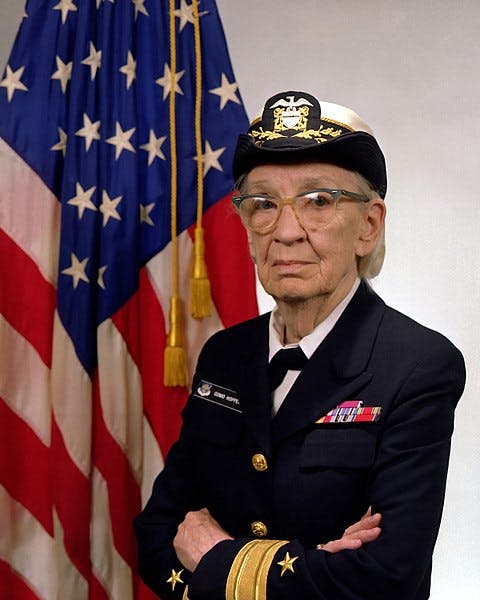
格蕾丝-霍珀 1984 年肖像
Topics my cards cover
我的贺卡涵盖的主题
I Ankify things I learn from coding, books, podcasts, conversations, etc. My primary interest right now is remembering software engineering concepts, syntax, and commands, e.g. SQL commands, git sequences, system design concepts, browser APIs, and so on. I also Ankify tangential topics like the history of computing and completely unrelated ones like brain anatomy and cooking science/ingredients. In short, if there’s anything I think is worth remembering for the rest of my life, I Ankify it.
我把从编码、书籍、播客、对话等中学到的东西整理成文字。我现在最感兴趣的是记住软件工程的概念、语法和命令,例如 SQL 命令、git 序列、系统设计概念、浏览器 API 等。此外,我还喜欢计算机历史等切身话题,以及大脑解剖学和烹饪科学/食材等完全不相关的话题。总之,只要是我认为值得终生铭记的东西,我都会将其 Ankify。
Looking forward展望未来
A few years ago I used to say, "I’ll only have a high probability of remembering something if I tell someone about it or write it down." The word learning researchers use for that is elaboration (learned in Make It Stick), which is known to strengthen learning. The problem with my old strategy is that it was random. What if I didn’t have the chance to write something down or tell someone? Or even if I did, without introducing recall and spaced repetition, the learning would fade anyway.
几年前,我常说:"只有把一件事告诉别人或写下来,我才有很大可能记住它"。学习研究人员用 "精心设计"(elaboration)来形容这句话,众所周知,"精心设计 "可以加强学习效果。我以前的策略的问题在于它是随机的。如果我没有机会写下来或告诉别人呢?或者即使我有机会,如果不引入回忆和间隔重复,学习效果也会逐渐消失。
Anki has been very empowering because it eliminates that randomness. It also increases my awareness of how what I think is worth learning changes over time. Did I add a bunch of cards a few months ago about some isolated topic that doesn’t connect to the rest of my knowledge? Maybe that wasn’t time well spent. Or maybe it was! There are obviously infinite things to learn, so I like that I am more aware of how I allocate my learning budget (i.e. time).
Anki 消除了这种随机性,因此给了我很大的启发。它还让我意识到,我认为值得学习的东西是如何随着时间的推移而变化的。几个月前,我是否添加了一堆卡片,内容是一些与我其他知识不相关的孤立主题?也许我没有好好利用时间。也许是的!要学的东西显然是无穷无尽的,所以我喜欢这样的感觉:我更清楚自己如何分配学习预算(即时间)。
This is still a very new habit for me, so I’m curious how it evolves. On that note, please reach out if you have your own Anki observations to share (or any observations, really)—I like talking about this stuff.
这对我来说还是个新习惯,所以我很好奇它是如何发展的。关于这一点,如果您有自己对 Anki 的看法要分享(或任何看法,真的),请联系我--我喜欢谈论这些东西。